In the first module of the Teaching and Learning Lab Practicum, we were asked to explore core theoretical concepts related to how people learn and how we can design instruction that employs those concepts.
We were also asked to consider how ongoing projects at the Teaching and Learning lab can help us meet personal learning goals.
My personal learning goals are as follows:
- Continue to apply (and refine my understanding of) the design process. Last year was the first year I was formally introduced to design thinking. It wasn’t a completely foreign concept. Most design process formulations share similarities with both the scientific process and the engineering process. However, the key step of empathizing with the user (or in our case, learner) was new to me. I have since conducted surveys, semi-structured interviews, think-aloud protocols, and focus groups to better understand learners for specific projects. I want to practice the applying knowledge about learners to education products.
- Advance my technical skills. I have been working on getting to know Tableau for data visualization, improving my Adobe and Articulate suite for visual and learning design, and learning R for statistical analysis. I hope that T127 will either give me the opportunity to deepen an existing skill set or serve as an entry point to a new technical domain.
- Gain more experience with adult learning, especially Higher Ed. I am passionate about science and STEM education in both formal and informal settings. I have experience in the K-12 space and corporate training. Higher Ed is a current gap. I want to learn about working with faculty and best practices for creating learning experiences for college and professional students.
- Increase confidence in the role of an instructional/learning designer. This goal is especially pertinent with how much power dynamics have been emphasized in the Discover module.
Several of the ongoing projects at the Teaching and Learning Lab align with these goals, including the “Teaching Online” Course Re-design; Use Cases for the IT Canvas Space; and Media Workshop Develelopment.
However, the Role Plays / Simulation project seems especially exciting for multiple reasons:

Previous T127 students have completed the initial stages of the project. By researching simulation pedagogy and conducting empathy mapping, Alessa Lopez and Sabina Zacco have set us up to move rapidly into the pilot testing phase.
Under the ADDIE model, we can consider much of the work under the “Analyze” step to be completed.

Under the IDEO hexagons, we can consider the “Empathize,” “Define,” and “Ideate” steps to be completed.

Of course, the design process is iterative. We may need to revisit earlier stages, such as reworking learner profiles or re-defining the problem, but the work already done gives us a solid foundation to pilot a prototype.

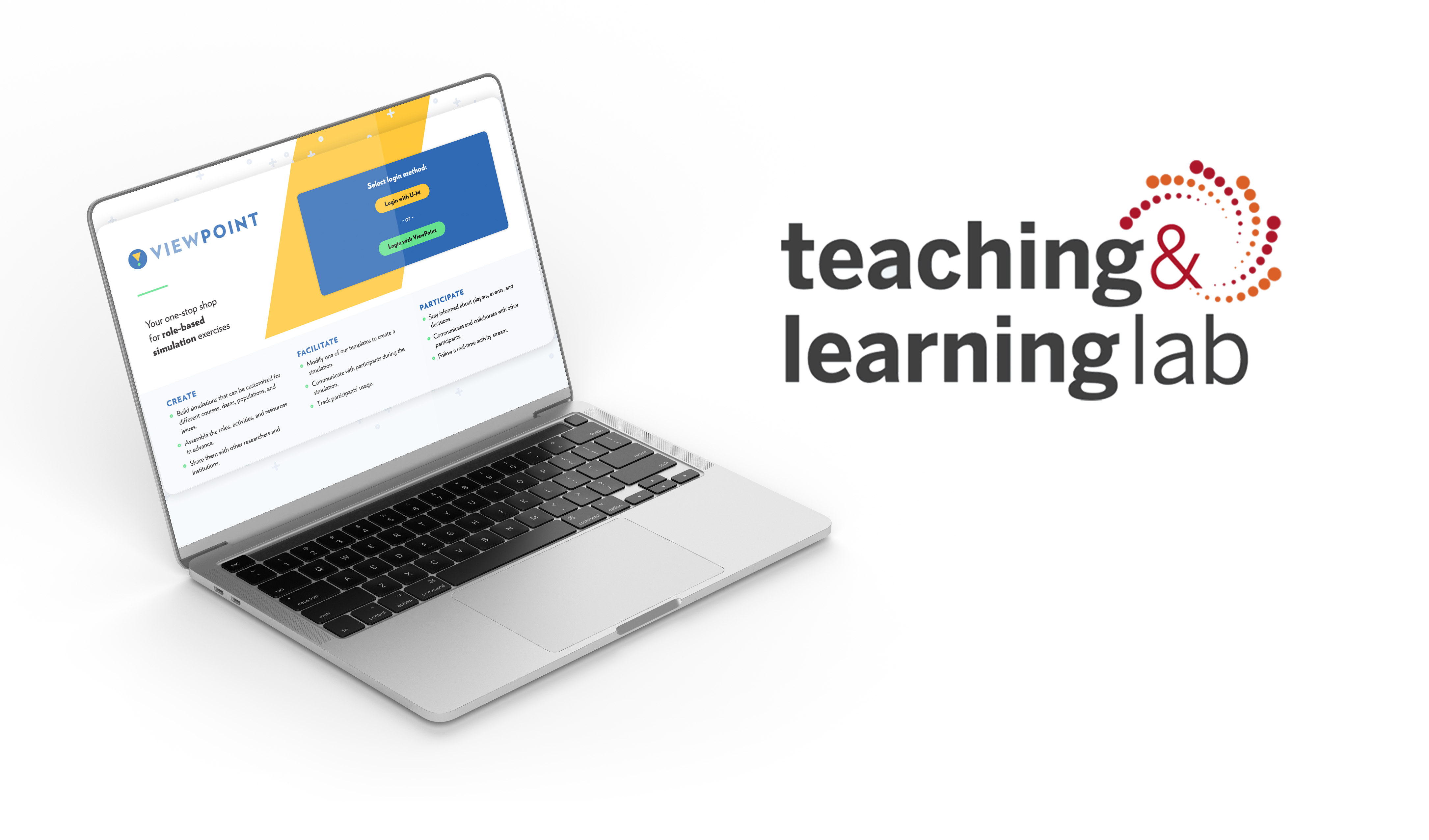
The Viewpoint platform offers an entry point into simulation design and testing. The Viewpoint platform may not be widely used as it is quite new. However, simulations / role-playing / scenario-based learning are used widely in adult learning and higher ed. The logic of branching paths is an interesting design challenge. Viewpoint’s documentation states that it is capable of “visualizing contingencies in your simulation. Create events that will only occur if other events happen first.” I am also interested in how the platform might be integrated with other digital technologies such as Canvas or Zoom.

The project simulates a kick-off meeting in higher ed and will be pilot tested with real graduate students. This is an amazing opportunity to create something that could be valuable for both future T127 students, and students in the Online Education Leadership program.

The project focuses on the role of an instructional designer in content as well as action. The primary role being simulated is that of the instructional designer. Many of the learning goals will be focused on communicating instructional design to different stakeholders.
Leave a Reply